By the end, Rango isn’t a hero because he kills the rattlesnake. He’s a hero because he finally accepts that the chameleon in the glass box and the sheriff of Dirt are the same lizard. He stops acting and starts being . In a world of filters and facades, Rango reminds us that the most courageous thing you can do is simply walk into the desert and own your name. Even if you made it up five minutes ago.

The film is a technical marvel of motion capture, but unlike the sterile performances of The Polar Express , Verbinski allowed his actors to improvise physically. The result is a fluidity that feels almost stop-motion in its tactile weirdness. Every scale, every squint, every twitch of Rango’s tongue feels organic. The cinematography by Roger Deakins (a live-action legend who served as visual consultant) gives the desert the weight of a Leone epic—long shadows, golden hour glares, and a sense of overwhelming isolation. Hans Zimmer’s score is another character entirely. It swerves from soaring Ennio Morricone homages (complete with twangy guitars and dramatic trumpets) to the absurdist folk of “Rango Suite,” which features a chorus of men shouting “Rango!” like a war cry. The sound design is equally visceral: the slither of Jake’s rattle, the gurgle of a dying water faucet, the screech of the hawk. It’s a sensory overload that demands a good sound system. Why It Matters Today In an era where animated films are often sanitized for mass consumption, Rango remains radical. It is a PG movie that respects its audience enough to be scary (the bat sequence is pure horror), confusing (the metaphysical journey across the roadkill highway), and literate. It references Chinatown , Fear and Loathing in Las Vegas , and The Good, the Bad and the Ugly without winking at the camera.

But Verbinski and screenwriter John Logan pull the rug out immediately. Rango isn’t brave; he’s a liar. When he finally faces the villainous Mayor (a geriatric tortoise voiced by Ned Beatty) and his deadly pet, the rattlesnake Jake (Bill Nighy), Rango’s constructed world collapses. In a devastating third-act sequence, the truth comes out: he is nobody. He is a fraud. The townsfolk, betrayed, banish him into the desert night.

At first glance, Rango seems like a hard sell. The protagonist is an unnamed, neurotic pet chameleon (voiced with manic brilliance by Johnny Depp) who lives in a terrarium, staging melodramatic one-lizard shows. He is a creature of artifice, defined by his surroundings. But when an accident flings him from the air-conditioned comfort of his owner’s car onto the scorching asphalt of the Mojave Desert, his survival depends on the one thing he lacks: authenticity. What makes Rango so compelling is its refusal to let its hero be comfortable. Stranded in the parched, lawless town of Dirt, our hero invents a new identity on the spot. He is "Rango," a tough drifter from the West who has killed seven men with one bullet. He bluffs his way into becoming the town sheriff, standing up to a menacing hawk and the fearsome gang of rattlesnakes led by the terrifying Jake.

Rango won the Academy Award for Best Animated Feature, beating out Kung Fu Panda 2 and A Cat in Paris . But awards undersell it. This is not merely a great animated film; it is a great film , period. It understands that the Western genre isn’t about gunfights or horses; it’s about the lonely, terrifying act of forging a self in a land that wants to kill you.

More importantly, Rango is a meditation on water rights, political corruption, and the manipulation of fear—themes that feel depressingly relevant. The Mayor doesn’t want to kill Rango because he’s evil; he wants to control the water supply to build a Las Vegas-style monument to greed. It’s a critique of unchecked capitalism wrapped in a lizard western.

In the sprawling landscape of modern animated cinema, where sequels dominate box offices and focus-grouped sidekicks are designed to sell plush toys, one film stands as a beautiful, dusty, and gloriously bizarre anomaly: Rango . Released in 2011 by Paramount Pictures and Nickelodeon Movies, this Gore Verbinski-directed feature is not just a film about a chameleon; it is a philosophical, psychedelic, and surprisingly violent love letter to the Western genre. It is a movie that dared to ask: what happens when a sheltered pet tries to become a mythic hero, only to discover that identity is the hardest role of all?

This is the film’s secret weapon: its existential dread. For a children’s movie, Rango deals heavily with the terror of the unreliable self . In a famous, surreal scene, Rango meets the Spirit of the West—a Clint Eastwood-esque phantom driving a golf cart. When Rango asks for a solution, the spirit tells him, “No man can walk out of his own story.” It is a beautiful, terrifying reminder that you cannot run from who you are; you can only control the story you tell about it. While Pixar was polishing every surface to a hyper-realistic sheen, ILM (Industrial Light & Magic) gave Rango a texture of decay and dust. The animation is deliberately ugly in the most beautiful way possible. The characters are wrinkled, sun-scorched, and bug-eyed. The town of Dirt looks like a fever dream of a ghost town, built from junk and held together by desperation.

Related posts

Rango Apr 2026

By the end, Rango isn’t a hero because he kills the rattlesnake. He’s a hero because he finally accepts that the chameleon in the glass box and the sheriff of Dirt are the same lizard. He stops acting and starts being . In a world of filters and facades, Rango reminds us that the most courageous thing you can do is simply walk into the desert and own your name. Even if you made it up five minutes ago.

The film is a technical marvel of motion capture, but unlike the sterile performances of The Polar Express , Verbinski allowed his actors to improvise physically. The result is a fluidity that feels almost stop-motion in its tactile weirdness. Every scale, every squint, every twitch of Rango’s tongue feels organic. The cinematography by Roger Deakins (a live-action legend who served as visual consultant) gives the desert the weight of a Leone epic—long shadows, golden hour glares, and a sense of overwhelming isolation. Hans Zimmer’s score is another character entirely. It swerves from soaring Ennio Morricone homages (complete with twangy guitars and dramatic trumpets) to the absurdist folk of “Rango Suite,” which features a chorus of men shouting “Rango!” like a war cry. The sound design is equally visceral: the slither of Jake’s rattle, the gurgle of a dying water faucet, the screech of the hawk. It’s a sensory overload that demands a good sound system. Why It Matters Today In an era where animated films are often sanitized for mass consumption, Rango remains radical. It is a PG movie that respects its audience enough to be scary (the bat sequence is pure horror), confusing (the metaphysical journey across the roadkill highway), and literate. It references Chinatown , Fear and Loathing in Las Vegas , and The Good, the Bad and the Ugly without winking at the camera.

But Verbinski and screenwriter John Logan pull the rug out immediately. Rango isn’t brave; he’s a liar. When he finally faces the villainous Mayor (a geriatric tortoise voiced by Ned Beatty) and his deadly pet, the rattlesnake Jake (Bill Nighy), Rango’s constructed world collapses. In a devastating third-act sequence, the truth comes out: he is nobody. He is a fraud. The townsfolk, betrayed, banish him into the desert night. By the end, Rango isn’t a hero because

At first glance, Rango seems like a hard sell. The protagonist is an unnamed, neurotic pet chameleon (voiced with manic brilliance by Johnny Depp) who lives in a terrarium, staging melodramatic one-lizard shows. He is a creature of artifice, defined by his surroundings. But when an accident flings him from the air-conditioned comfort of his owner’s car onto the scorching asphalt of the Mojave Desert, his survival depends on the one thing he lacks: authenticity. What makes Rango so compelling is its refusal to let its hero be comfortable. Stranded in the parched, lawless town of Dirt, our hero invents a new identity on the spot. He is "Rango," a tough drifter from the West who has killed seven men with one bullet. He bluffs his way into becoming the town sheriff, standing up to a menacing hawk and the fearsome gang of rattlesnakes led by the terrifying Jake.

Rango won the Academy Award for Best Animated Feature, beating out Kung Fu Panda 2 and A Cat in Paris . But awards undersell it. This is not merely a great animated film; it is a great film , period. It understands that the Western genre isn’t about gunfights or horses; it’s about the lonely, terrifying act of forging a self in a land that wants to kill you. In a world of filters and facades, Rango

More importantly, Rango is a meditation on water rights, political corruption, and the manipulation of fear—themes that feel depressingly relevant. The Mayor doesn’t want to kill Rango because he’s evil; he wants to control the water supply to build a Las Vegas-style monument to greed. It’s a critique of unchecked capitalism wrapped in a lizard western.

In the sprawling landscape of modern animated cinema, where sequels dominate box offices and focus-grouped sidekicks are designed to sell plush toys, one film stands as a beautiful, dusty, and gloriously bizarre anomaly: Rango . Released in 2011 by Paramount Pictures and Nickelodeon Movies, this Gore Verbinski-directed feature is not just a film about a chameleon; it is a philosophical, psychedelic, and surprisingly violent love letter to the Western genre. It is a movie that dared to ask: what happens when a sheltered pet tries to become a mythic hero, only to discover that identity is the hardest role of all? The result is a fluidity that feels almost

This is the film’s secret weapon: its existential dread. For a children’s movie, Rango deals heavily with the terror of the unreliable self . In a famous, surreal scene, Rango meets the Spirit of the West—a Clint Eastwood-esque phantom driving a golf cart. When Rango asks for a solution, the spirit tells him, “No man can walk out of his own story.” It is a beautiful, terrifying reminder that you cannot run from who you are; you can only control the story you tell about it. While Pixar was polishing every surface to a hyper-realistic sheen, ILM (Industrial Light & Magic) gave Rango a texture of decay and dust. The animation is deliberately ugly in the most beautiful way possible. The characters are wrinkled, sun-scorched, and bug-eyed. The town of Dirt looks like a fever dream of a ghost town, built from junk and held together by desperation.
To Serve Man, with Software

To Serve Man, with Software

I didn’t choose to be a programmer. Somehow, it seemed, the computers chose me. For a long time, that was fine, that was enough; that was all I needed. But along the way I never felt that being a programmer was this unambiguously great-for-everyone career field with zero downsides.

By Jeff Atwood ·
Comments
Here’s The Programming Game You Never Asked For

Here’s The Programming Game You Never Asked For

You know what’s universally regarded as un-fun by most programmers? Writing assembly language code. As Steve McConnell said back in 1994: Programmers working with high-level languages achieve better productivity and quality than those working with lower-level languages. Languages such as C++, Java, Smalltalk, and Visual Basic have been credited

By Jeff Atwood ·
Comments
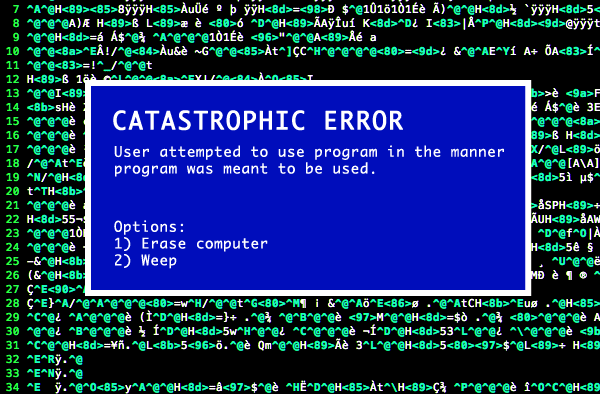
Catastrophic error: User attempted to use program in the manner program was meant to be used. Options 1) Erase computer 2) Weep

Doing Terrible Things To Your Code

In 1992, I thought I was the best programmer in the world. In my defense, I had just graduated from college, this was pre-Internet, and I lived in Boulder, Colorado working in small business jobs where I was lucky to even hear about other programmers much less meet them. I

By Jeff Atwood ·
Comments

Recent Posts

map of the United States via rgmii.org showing all 3,143 counties by rural (gold) / metro (grey) and population

Launching The Rural Guaranteed Minimum Income Initiative

It's been a year since I invited Americans to join us in a pledge to Share the American Dream: 1. Support organizations you feel are effectively helping those most in need across America right now. 2. Within the next five years, also contribute public dedications of time or

By Jeff Atwood ·
Comments
Let's Talk About The American Dream

Let's Talk About The American Dream

A few months ago I wrote about what it means to stay gold — to hold on to the best parts of ourselves, our communities, and the American Dream itself. But staying gold isn’t passive. It takes work. It takes action. It takes hard conversations that ask us to confront

By Jeff Atwood ·
Comments
Stay Gold, America

Stay Gold, America

We are at an unprecedented point in American history, and I'm concerned we may lose sight of the American Dream.

By Jeff Atwood ·
Comments
I’m feeling unlucky... 🎲   See All Posts